Embodiment Verb: How to Actually Live Your Faith
May 27, 2026 · 12 minute read · Ashley | Faith Soulcial
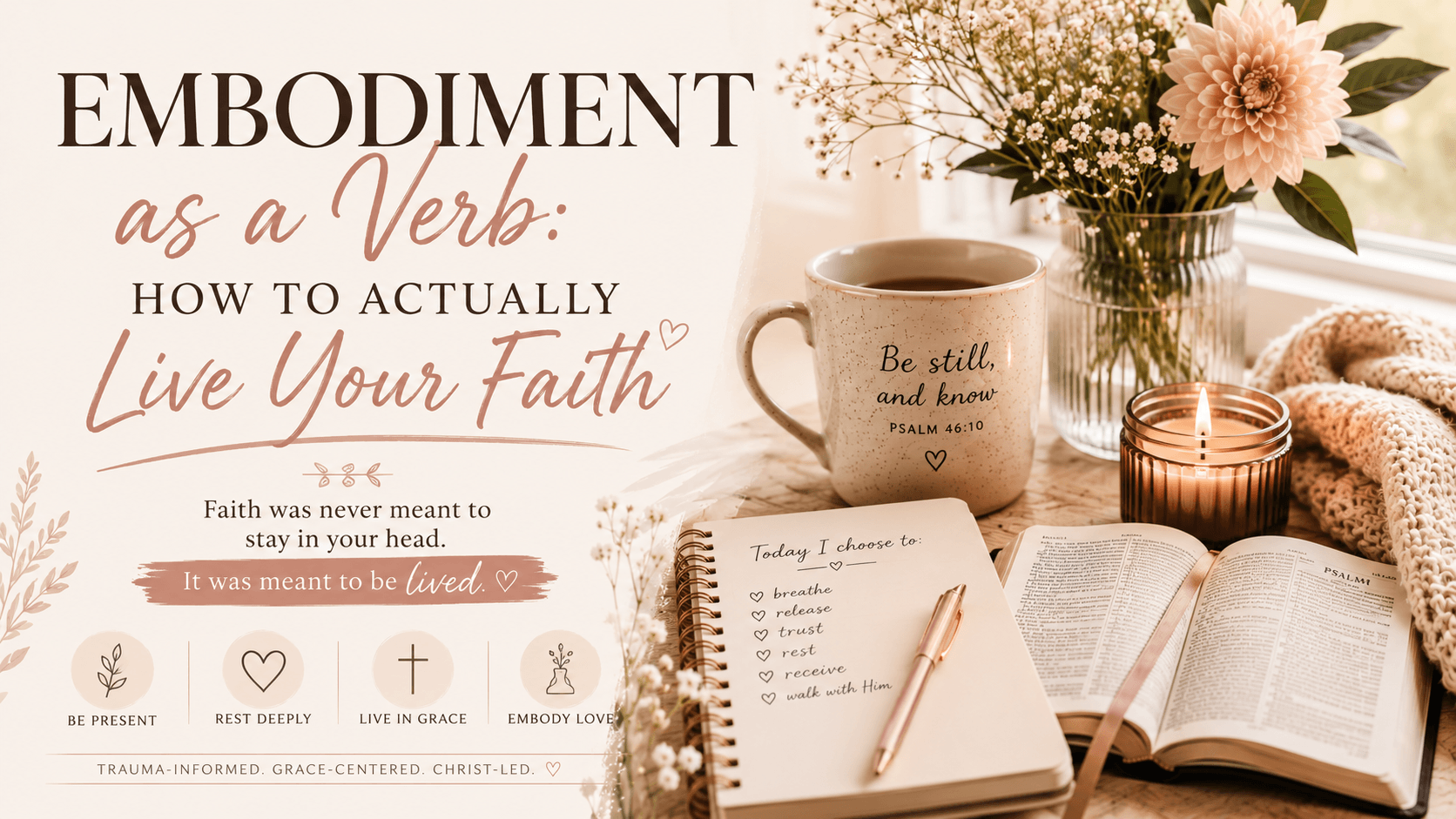
Table of Contents
- What Is the Meaning of Embodiment? Starting with the Basics
- Embodiment Meaning in English: The Literal and the Lived
- Embodiment Synonym: Words That Circle the Same Truth
- Embodiment in a Sentence — and Why Context Changes Everything
- Embodiment Verb: A Reframe That Changes How You Practice Faith
- Why Treating Faith as a Noun Keeps Women Stuck
- What It Means to Embody Faith Rather Than Perform It
- Embodiment Verb Meaning in Psychology: What the Research Actually Says
- Somatic Awareness, Nervous System Safety, and Spiritual Health
- Where Secular Psychology Ends and the Christian Embodiment Verb Begins
- How Coaching Culture and New Age Spirituality Co-opted Embodiment
- Manifestation, Self-Optimization, and the Distortion of Embodied Practice
- Spiritual Bypassing: When “Embodiment” Skips the Body Entirely
- Why Performance-Based Faith Is Also a Form of Disembodiment
- The Spiritual Exhaustion That Comes from Living Faith in Your Head
- Signs You May Be Performing Faith Rather Than Living It
- Embodiment of Beauty Meaning and the Deeper Theological Picture
- The Body as Image-Bearer: A Biblical Case for Embodied Faith
- Incarnation as the Ultimate Embodiment Example
- Embodiment Meaning and Examples in Everyday Christian Practice
- Embodiment Examples for Women Healing from Spiritual Burnout
- Embodiment Examples for Women Returning from New Age or Coaching Culture
- Small, Nervous-System-Safe Ways to Begin Embodying Your Faith Today
- The Embodied Faith™ Framework: What Makes This Approach Different
- Trauma-Informed Christianity and the Permission to Slow Down
- You Are Not Behind. Embodiment Is Not a Performance Metric.
- A Gentle Invitation Back to God — In Your Whole Self
- A Gentle Invitation to Continue This Journey
- FAQs
Embodiment Verb: How to Actually Live Your Faith
Embodiment verb: Faith was never meant to stay theoretical.
It was never meant to live only in Bible studies, podcasts, theology discussions, or perfectly curated Christian routines. Faith was always meant to become lived experience — something expressed through the body, relationships, emotions, nervous system, habits, and ordinary rhythms of daily life.
But I think many women today feel deeply disconnected from that reality.
I know I did.
For years, I lived inside a strange mixture of Christian performance culture, coaching culture, self-development spaces, nervous system language, and eventually New Age spirituality. I consumed endless information about healing, growth, alignment, spirituality, and personal transformation.
And honestly?
I became incredibly spiritually informed while simultaneously becoming emotionally exhausted.
I knew how to talk about faith.
I knew how to perform spirituality.
I knew how to sound wise and self-aware.
But I had no idea how to safely inhabit my actual life with God.
And I think that is why embodiment as a verb matters so deeply.
Because embodiment is not merely something we understand.
It is something we practice.
What Is the Meaning of Embodiment? Starting with the Basics
At its simplest level, embodiment means expressing something through lived reality.
To embody something means it becomes visible through you.
For example:
- A woman can embody compassion.
- A leader can embody integrity.
- Jesus embodied grace and truth.
Embodiment takes an invisible idea and makes it tangible through action, presence, and lived experience.
Spiritually, embodiment means faith moves beyond intellectual agreement and becomes something practiced in everyday life.
Embodiment Meaning in English: The Literal and the Lived
The word embodiment literally means “giving bodily form to something.”
In English, it refers to:
- expression
- representation
- visible form
- lived reality
But the lived meaning goes deeper.
Embodiment is not merely about appearance or behavior.
It is about integration.
What you believe inwardly begins shaping how you actually live outwardly.
This matters profoundly for women because many of us were taught faith as information rather than transformation.
Embodiment Synonym: Words That Circle the Same Truth
Some common embodiment synonyms include:
- manifestation
- expression
- personification
- representation
- incarnation
Each word circles part of the same truth.
But embodiment uniquely captures the idea of full integration:
mind,
body,
spirit,
emotions,
actions,
and presence all aligning together.
And honestly, I think many women are exhausted precisely because their lives feel fragmented rather than integrated.
Embodiment in a Sentence — and Why Context Changes Everything
The meaning of embodiment changes depending on context.
For example:
- “She became the embodiment of kindness.”
- “The coach taught embodiment practices.”
- “Jesus is the embodiment of God’s love.”
- “Embodied faith helped her reconnect with God after burnout.”
In wellness spaces, embodiment often centers around self-expression and nervous system regulation.
In psychology, embodiment relates to the mind-body connection.
In Christianity, embodiment becomes deeply relational and theological.
Context changes everything.
Embodiment Verb: A Reframe That Changes How You Practice Faith
Here is where the conversation shifts.
Embodiment is not just a noun.
It is a verb.
To embody means:
- to live out
- to practice
- to express
- to carry into reality
This reframing changes faith entirely.
Because faith stops becoming something you merely possess and starts becoming something you participate in.
You embody faith when you:
- forgive someone honestly
- rest when exhausted
- speak gently
- tell the truth
- allow yourself to grieve
- trust God slowly
- remain present during discomfort
- love people imperfectly
Embodiment turns spirituality from performance into lived relationship.
Why Treating Faith as a Noun Keeps Women Stuck
Many women unconsciously treat faith like a static possession.
Something to maintain.
Something to defend.
Something to prove.
This often creates:
- perfectionism
- anxiety
- comparison
- guilt
- spiritual exhaustion
- emotional suppression
Faith becomes intellectualized instead of relational.
I think many women know Scripture deeply while simultaneously feeling disconnected from themselves, their bodies, and even from God emotionally.
That disconnect matters.
What It Means to Embody Faith Rather Than Perform It
Performative faith focuses on appearance.
Embodied faith focuses on presence.
Performance asks:
- “How do I look spiritually?”
- “Am I doing enough?”
- “Do people think I’m faithful?”
- “Am I spiritually successful?”
Embodied faith asks:
- “Am I honestly connected to God?”
- “Am I living truthfully?”
- “Am I safe enough to be present?”
- “Am I allowing grace into my real life?”
This distinction changed my entire relationship with Christianity.
Because for years I confused striving with spiritual maturity.
Embodiment Verb Meaning in Psychology: What the Research Actually Says
In psychology, embodiment refers to the connection between the body and mind.
Researchers increasingly recognize that emotions, memory, trauma, stress, and identity are not purely mental experiences. The body participates in all of it.
Trauma especially affects embodiment.
Women who have lived through:
- chronic stress
- burnout
- spiritual abuse
- emotionally unsafe environments
- perfectionism
- survival mode
often disconnect from their bodies as protection.
This can make spiritual connection difficult too.
Somatic Awareness, Nervous System Safety, and Spiritual Health
Somatic awareness simply means noticing what is happening inside the body.
Things like:
- tension
- exhaustion
- breath
- emotional overwhelm
- numbness
- safety
- grounding
This matters spiritually because the nervous system affects how safe we feel being present.
When women live in chronic survival mode:
- silence may feel threatening
- prayer may feel inaccessible
- stillness may create anxiety
- worship may feel emotionally disconnected
This does not mean faith is weak.
It means the body matters more than many church environments acknowledged.
Where Secular Psychology Ends and the Christian Embodiment Verb Begins
Psychology offers valuable insight into trauma, nervous system health, emotional regulation, and healing.
But Christianity offers something psychology alone cannot:
grace.
Psychology can explain why women feel fragmented.
But the Gospel tells women they are loved even while healing.
This is the difference.
Christian embodiment is not self-salvation.
It is relationship with God within the reality of our humanity.
How Coaching Culture and New Age Spirituality Co-opted Embodiment
Modern coaching and New Age spaces often use embodiment language heavily.
Women are taught to embody:
- abundance
- feminine energy
- magnetism
- confidence
- success
- “high-vibe” living
At first, some of this language can sound empowering.
But eventually embodiment becomes another performance standard women cannot sustain.
I know because I lived inside that world.
Healing became optimization.
Spirituality became image management.
Even rest became strategic.
Manifestation, Self-Optimization, and the Distortion of Embodied Practice
Manifestation culture subtly teaches women:
- your thoughts create reality
- your energy determines outcomes
- your vibration shapes your life
This creates enormous pressure.
Suddenly everything becomes your responsibility:
your healing,
your beauty,
your abundance,
your relationships,
your emotional state.
Women become exhausted trying to spiritually engineer perfect lives.
But embodied Christian faith moves in the opposite direction.
Toward surrender.
Toward trust.
Toward rest.
Spiritual Bypassing: When “Embodiment” Skips the Body Entirely
Spiritual bypassing happens when spirituality is used to avoid genuine emotional reality.
Ironically, many “embodiment” spaces still encourage bypassing.
Examples include:
- toxic positivity
- avoiding grief
- suppressing anger
- pretending to feel peaceful
- performing emotional regulation
- forcing constant gratitude
I did this for years.
I thought being spiritually mature meant becoming emotionally untouched.
But Jesus Himself wept openly.
Embodied faith allows humanity instead of suppressing it.
Why Performance-Based Faith Is Also a Form of Disembodiment
Performance-based Christianity disconnects women from themselves.
Women learn to:
- override exhaustion
- suppress emotions
- stay endlessly productive
- ignore bodily needs
- appear spiritually strong at all times
Eventually the body stops feeling safe.
And many women quietly lose connection with themselves while trying desperately to stay “faithful.”
That is disembodiment too.
The Spiritual Exhaustion That Comes from Living Faith in Your Head
Head-only faith eventually becomes exhausting.
You may:
- consume endless spiritual content
- overanalyze theology
- constantly self-monitor spiritually
- feel guilty resting
- struggle to feel emotionally connected to God
- feel numb during prayer
I think many women are carrying this exhaustion silently.
Not because they do not love God.
But because they learned spirituality through pressure instead of relationship.
Signs You May Be Performing Faith Rather Than Living It
You may be performing faith if:
- you constantly feel spiritually inadequate
- rest creates guilt
- your relationship with God feels transactional
- you hide emotional struggles
- you feel pressure to appear “strong”
- your faith feels anxious rather than grounded
- you obsess over spiritual productivity
Many women do not realize how exhausted they truly are until they finally slow down.
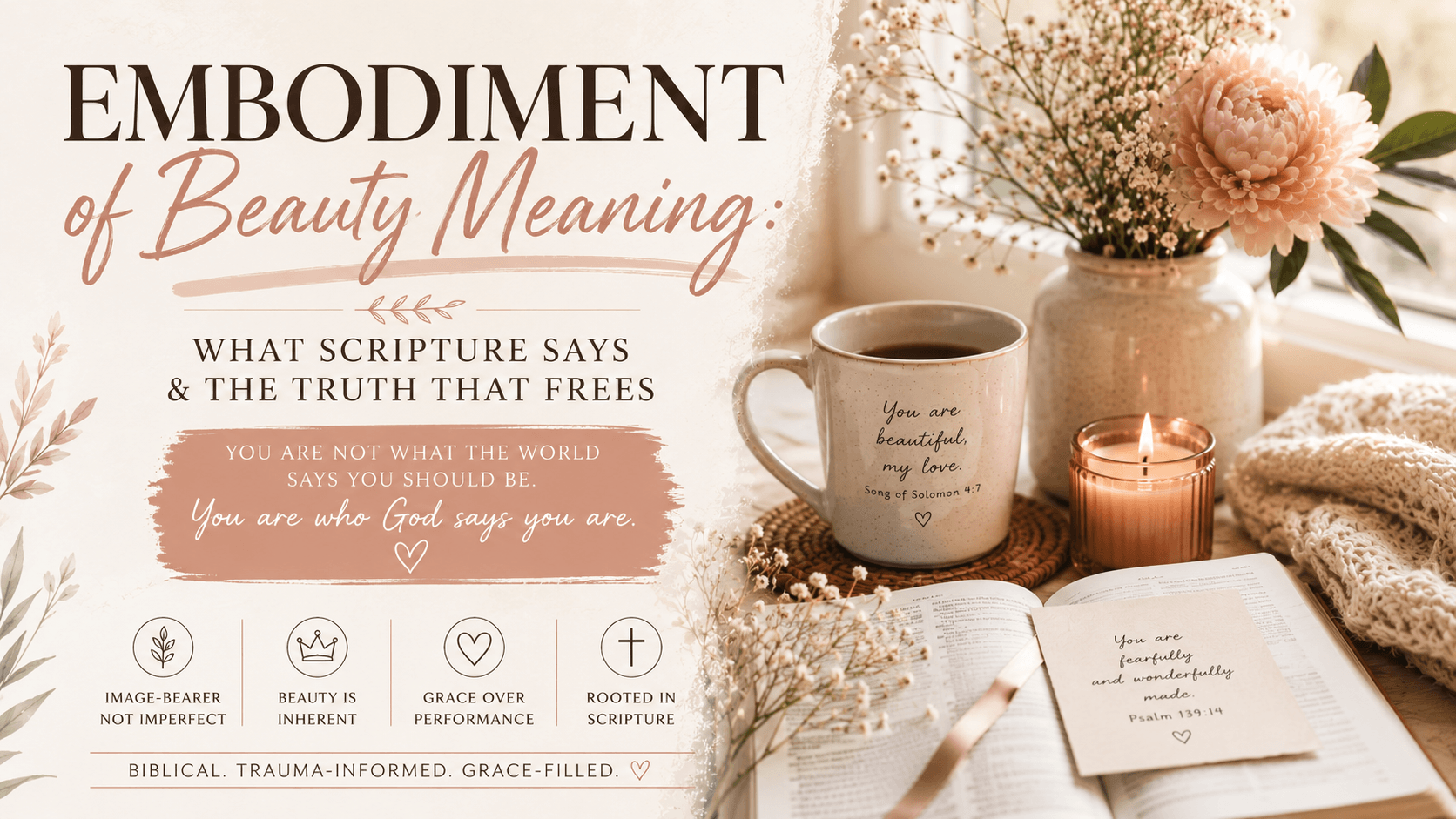
Embodiment of Beauty Meaning and the Deeper Theological Picture
When culture speaks about the “embodiment of beauty,” it often means external perfection.
But biblically, beauty is something deeper.
Humans reflect God’s image.
Beauty is not merely appearance.
It is integrity.
Compassion.
Presence.
Love.
Peace.
Gentleness.
True beauty flows from relationship with God rather than constant self-optimization.
The Body as Image-Bearer: A Biblical Case for Embodied Faith
Scripture teaches that humans are created in the image of God.
This means the body matters.
Not because it should be worshipped.
But because it is part of God’s intentional design.
Christianity rejects both:
- body shame
- body obsession
Instead, embodied faith honors the body as part of human wholeness.
Incarnation as the Ultimate Embodiment Example
The Incarnation changes everything.
God became flesh.
Jesus entered fully into human experience:
- grief
- hunger
- fatigue
- suffering
- touch
- tears
- presence
Christianity has always been embodied.
God did not reject humanity.
He entered it.
Embodiment Meaning and Examples in Everyday Christian Practice
Embodied faith often looks ordinary.
It may look like:
- taking a deep breath before reacting
- praying honestly instead of perfectly
- resting when exhausted
- crying during worship
- apologizing sincerely
- eating nourishing meals
- spending quiet time outside
- choosing gentleness toward yourself
Often the holiest moments are far less dramatic than social media suggests.
Embodiment Examples for Women Healing from Spiritual Burnout
For spiritually exhausted women, embodiment may begin very simply:
- sitting quietly with God for five minutes
- noticing tension in the body compassionately
- allowing tears without shame
- taking breaks without guilt
- reading one Psalm slowly
- practicing breath prayer
Healing rarely begins through pressure.
It usually begins through safety.
Embodiment Examples for Women Returning from New Age or Coaching Culture
For women leaving New Age or coaching spaces, embodied faith may look like:
- releasing obsession with optimization
- letting go of manifestation practices
- embracing slower spiritual rhythms
- learning to trust God instead of controlling outcomes
- reconnecting with grace instead of self-perfection
Many women are not returning to God because of fear.
They are returning because they are exhausted.
Small, Nervous-System-Safe Ways to Begin Embodying Your Faith Today
You do not need a perfect spiritual routine.
You can begin gently:
- breathe deeply during prayer
- step outside without your phone
- listen to worship music quietly
- journal honestly
- allow rest
- drink water slowly and gratefully
- notice beauty around you
- speak to yourself with compassion
Small practices matter.
The Embodied Faith™ Framework: What Makes This Approach Different
Embodied Faith™ blends:
- trauma-informed care
- nervous system awareness
- emotional honesty
- biblical truth
- grace-centered spirituality
This approach recognizes that many women are carrying invisible exhaustion.
And healing cannot happen through more pressure.
Trauma-Informed Christianity and the Permission to Slow Down
Trauma-informed faith gives women permission to:
- rest
- grieve
- heal slowly
- question honestly
- feel emotions
- reconnect with their bodies safely
God is not demanding spiritual perfection from exhausted women.
He invites relationship.
You Are Not Behind. Embodiment Is Not a Performance Metric.
One of the most healing realizations for me personally was this:
Embodiment is not another achievement.
There is no spiritual leaderboard.
No perfect nervous system.
No ideal healing timeline.
You are not behind.
God is not rushing your healing.
A Gentle Invitation Back to God — In Your Whole Self
If you feel spiritually exhausted, disconnected, overwhelmed, or tired of striving, I want you to know this:
You do not need to perform faith perfectly to belong to God.
You do not need to optimize yourself into holiness.
You do not need to suppress your humanity to become lovable.
God welcomes your whole self:
body,
mind,
emotions,
questions,
weariness,
and all.
And maybe embodiment as a verb simply means this:
Learning how to fully live your real life with God instead of endlessly trying to escape it.
A Gentle Invitation to Continue This Journey
If this post resonated with you, I’d love to invite you to subscribe to the Embodied Faith™ newsletter — a soft place for women returning to God after spiritual exhaustion, burnout, New Age spirituality, performance-based faith, or simply feeling disconnected from themselves.
Inside the newsletter, we explore:
- trauma-informed Christianity
- embodied faith and nervous system safety
- emotional healing through a biblical lens
- rest in a culture of striving
- gentle spiritual practices
- returning to Christ without shame or pressure
This is not a space about becoming spiritually impressive.
It’s a space about learning how to be fully human in the presence of God again.
You do not need perfect faith to begin.
You do not need to have everything figured out.
You are not behind.
You are welcome here exactly as you are.
FAQs
Can embodied faith exist without emotional intensity?
Yes. Embodied faith is not about constantly feeling emotionally moved, inspired, or spiritually “high.” Sometimes embodied faith looks very quiet and ordinary — showing up honestly, choosing rest, practicing kindness, or staying connected to God during seasons where emotions feel muted or complicated.
Why do I feel uncomfortable slowing down spiritually?
For many women, busyness became emotionally protective. Constant productivity, learning, serving, scrolling, or self-improvement can prevent deeper emotions from surfacing. Slowing down may initially feel uncomfortable because your nervous system is no longer distracted from exhaustion, grief, fear, or overwhelm.
Does embodied faith mean I should trust all my feelings?
No. Embodied faith is not about letting emotions control your life or replace biblical wisdom. Instead, it means emotions are acknowledged honestly rather than ignored, shamed, or suppressed. Feelings become information to bring before God, not absolute truth to blindly follow.
Can embodiment help women who struggle with chronic anxiety or burnout?
For many women, yes. Gentle embodiment practices can help create greater nervous system safety, emotional awareness, and connection with God during stressful seasons. While embodiment is not a replacement for therapy, medical care, or spiritual support, it can become part of a more compassionate and sustainable way of living.
What if I feel disconnected from God after leaving New Age spirituality?
Want reflections like this in your inbox?
Subscribe to Embodied Faith™