Embodiment of Beauty Meaning: What Scripture Says
May 27, 2026 · 11 minute read · Ashley | Faith Soulcial
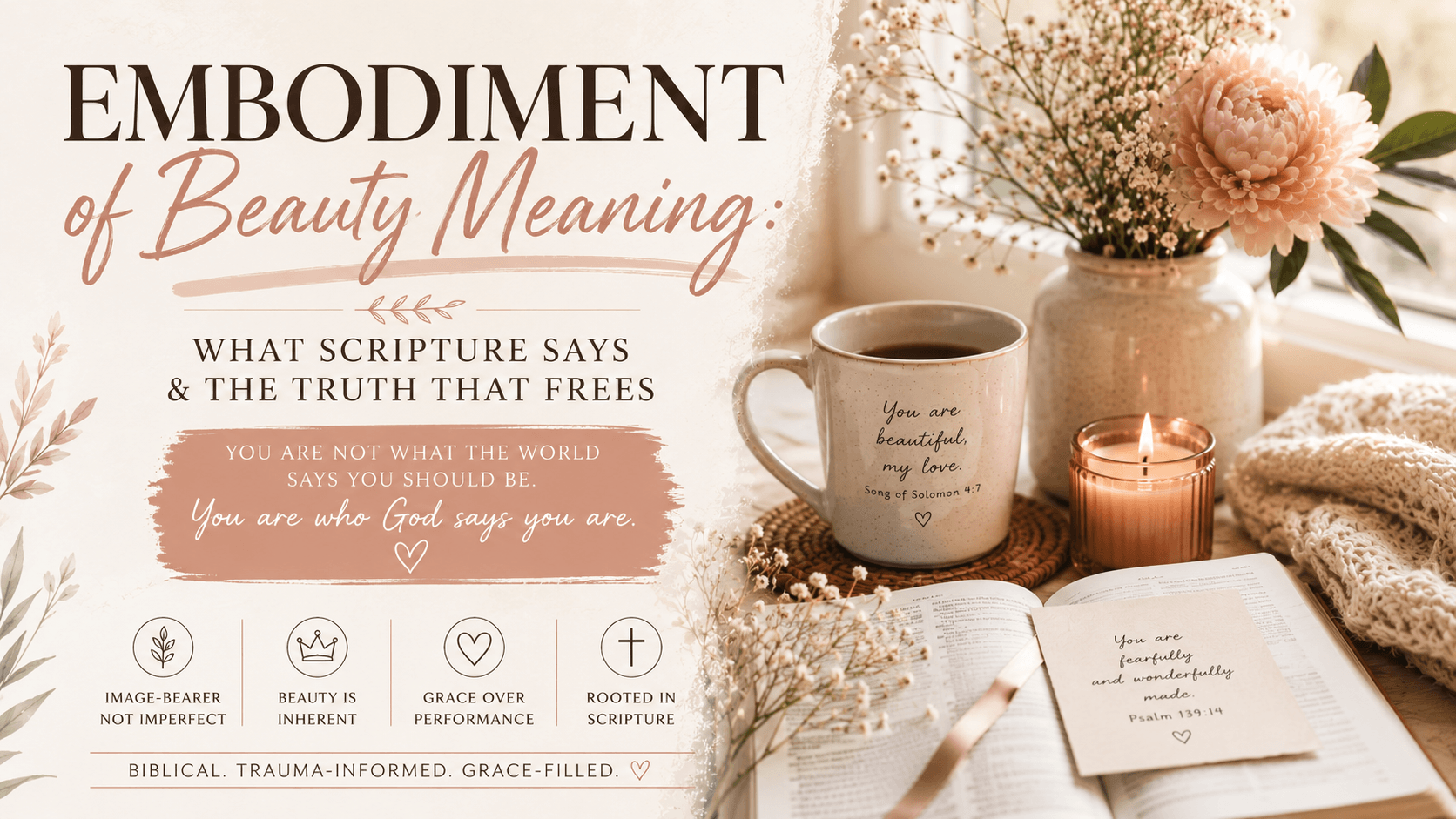
Table of Contents
- What Does Embodiment Mean? A Clear, Grounded Definition
- Embodiment Meaning in English: Word Roots and Core Concept
- Embodiment Synonym: Other Ways to Describe This Idea
- Embodiment in a Sentence: Everyday and Theological Examples
- Embodiment as a Verb: What It Means to Embody Something
- Embodiment Meaning in Psychology: What the Research Says
- Somatic Awareness and Nervous System Safety
- Where Psychology and Christian Faith Overlap — and Differ
- What Culture Says About the Embodiment of Beauty
- Wellness Culture’s Definition: Presence, Glow, and Self-Optimization
- Manifestation Culture and the Performance of Beauty
- Why These Messages Leave Women Exhausted, Not Free
- What Scripture Says About the Embodiment of Beauty
- Imago Dei: Beauty as Reflection, Not Achievement
- The Body as a Temple: A Biblical View of Physical Existence
- Biblical Embodiment Examples: Women in Scripture Who Reflected God’s Beauty
- Beauty That Is Not Performance: Proverbs 31 and 1 Peter 3 Unpacked
- Healing the Distorted View: Returning to God’s Definition of Beauty
- Spiritual Burnout and the Lie That You Must Earn Beauty
- What Embodied Faith™ Offers: Grace, Not a Glow-Up
- Practical Ways to Rest in Your Identity as an Image-Bearer
- You Don’t Have to Optimize — You Were Already Made Beautiful
- A Gentle Invitation to Continue This Journey
- FAQs
Embodiment of Beauty Meaning: What Scripture Says
If you’ve been searching for the embodiment of beauty meaning, you may be looking for more than a simple definition.
Maybe you’re exhausted by the endless messaging telling women they must become prettier, softer, healthier, more feminine, more radiant, more magnetic, more healed, more aligned, more confident, more optimized.
Maybe you’re tired of beauty feeling like another spiritual achievement.
I understand that exhaustion deeply.
For years, I lived immersed in wellness culture, coaching spaces, manifestation teachings, and self-optimization messaging that constantly promised transformation. Everything revolved around becoming “the embodiment” of something:
beauty,
abundance,
femininity,
healing,
success,
worth.
At first, it felt empowering.
But eventually I realized something heartbreaking:
I was spending more time trying to perfect myself than resting in the God who already loved me.
And I think many women today are spiritually exhausted from trying to earn a beauty that Scripture says was never meant to be earned in the first place.
Because biblical beauty is not performance.
It is presence.
It is wholeness.
It is the quiet radiance of a woman who knows she belongs to God.
What Does Embodiment Mean? A Clear, Grounded Definition
Before we can understand the embodiment of beauty meaning, we first need to understand the word embodiment itself.
Embodiment means expressing or giving visible form to something.
To embody something means it becomes lived through you.
For example:
- A woman can embody kindness.
- A leader can embody integrity.
- Jesus embodied love and grace.
Embodiment takes something abstract and makes it tangible.
Spiritually, embodiment means faith moves beyond intellectual belief and becomes something lived through the body, emotions, relationships, and daily rhythms of life.
Embodiment Meaning in English: Word Roots and Core Concept
The word embodiment comes from the idea of “putting into bodily form.”
In English, it refers to:
- expressing something visibly
- making an idea concrete
- representing something through action or presence
The core concept is integration.
What exists inwardly becomes outwardly expressed.
This matters deeply for women of faith because many of us were taught spirituality that lived mostly in the mind while our bodies carried exhaustion, shame, anxiety, or disconnection.
Embodiment Synonym: Other Ways to Describe This Idea
Some common embodiment synonyms include:
- manifestation
- expression
- representation
- personification
- incarnation
Each carries slightly different meaning.
Manifestation often focuses on bringing desires into reality.
Expression emphasizes outward communication.
Incarnation carries sacred theological meaning through Christ becoming flesh.
But embodiment uniquely points toward integration — the alignment of inner truth with outward life.
Embodiment in a Sentence: Everyday and Theological Examples
Here are a few embodiment examples in everyday language:
- “She became the embodiment of compassion.”
- “His life embodied humility.”
- “The garden was the embodiment of peace.”
And in theological contexts:
- “Jesus is the embodiment of God’s love.”
- “Embodied faith allows belief to become lived experience.”
- “Biblical beauty is the embodiment of inner peace and trust in God.”
Embodiment as a Verb: What It Means to Embody Something
To embody something is active.
It means you live it out.
This is important because Christian faith was never meant to remain theoretical.
We embody faith through:
- forgiveness
- gentleness
- rest
- compassion
- honesty
- humility
- love
Likewise, beauty in Scripture is not passive appearance management.
It is something expressed through character, peace, wisdom, and presence.
Embodiment Meaning in Psychology: What the Research Says
In psychology, embodiment refers to the connection between the body and mind.
Researchers increasingly recognize that our emotions, identities, memories, and stress responses are deeply connected to the body.
Trauma especially affects embodiment.
Women who have experienced emotional abuse, spiritual pressure, burnout, chronic criticism, or shame often disconnect from their bodies as a survival response.
This disconnection can affect:
- self-worth
- emotional regulation
- body image
- spirituality
- relationships
- identity
Which is why conversations about embodiment resonate so deeply for women right now.
Somatic Awareness and Nervous System Safety
Somatic awareness simply means paying attention to bodily sensations and nervous system responses.
For women healing from spiritual trauma or emotional exhaustion, this can feel revolutionary.
Many women spent years overriding themselves:
- ignoring exhaustion
- suppressing emotions
- pushing through burnout
- disconnecting from physical needs
The body stopped feeling safe.
And when the body feels unsafe, women often struggle to feel spiritually grounded too.
This was one of the biggest revelations in my own healing journey returning to Christ.
I realized I had spent years trying to transcend my humanity spiritually instead of learning how to safely inhabit it.
Where Psychology and Christian Faith Overlap — and Differ
Trauma-informed psychology and Christian faith overlap beautifully in some ways.
Both recognize:
- humans are deeply relational
- emotional wounds affect the whole person
- healing requires safety
- presence matters
But Christianity offers something psychology alone cannot:
grace.
Psychology can help explain why women feel disconnected.
But only the Gospel tells women they are fully loved before they become fully healed.
That changes everything.
What Culture Says About the Embodiment of Beauty
Culture defines the embodiment of beauty through appearance, desirability, confidence, youthfulness, productivity, and increasingly through wellness.
Beauty today is often tied to:
- glow
- discipline
- emotional mastery
- femininity
- aesthetics
- self-improvement
Even healing has become aestheticized online.
Women are subtly taught that if they heal “correctly,” they will become prettier, calmer, softer, more magnetic, more successful.
That pressure becomes exhausting.
Wellness Culture’s Definition: Presence, Glow, and Self-Optimization
Wellness culture often presents embodied beauty as:
- glowing skin
- nervous system regulation
- soft femininity
- mindfulness
- confidence
- “high-vibe” energy
Some of these practices are not inherently harmful.
But the underlying message often becomes:
you must optimize yourself endlessly to become worthy.
And many women quietly collapse under that pressure.
Manifestation Culture and the Performance of Beauty
Manifestation culture goes even further by linking beauty to vibration, mindset, energy, and self-belief.
Women are told:
- your thoughts create your reality
- your energy determines attraction
- your alignment affects your beauty
This creates a crushing emotional burden.
Suddenly beauty becomes moralized.
If you are struggling, anxious, aging, tired, or emotionally overwhelmed, you may feel like you are somehow failing spiritually.
I think many women became spiritually exhausted trying to maintain an impossible state of “alignment.”
Why These Messages Leave Women Exhausted, Not Free
The problem with self-optimization culture is that it never truly allows women to rest.
There is always another version of yourself to become.
Another routine.
Another healing modality.
Another mindset shift.
Another transformation.
And eventually women stop feeling human.
They begin feeling like projects.
But Scripture offers something radically different.
What Scripture Says About the Embodiment of Beauty
Biblically, beauty is not achievement.
It is reflection.
Beauty begins with belonging to God.
Women are image-bearers before they accomplish anything.
Before they heal fully.
Before they become confident.
Before they become productive.
Before they become aesthetically pleasing.
Beauty in Scripture flows from identity, not performance.
Imago Dei: Beauty as Reflection, Not Achievement
The doctrine of Imago Dei means humans are created in the image of God.
This reframes beauty entirely.
Beauty is not something women manufacture through optimization.
It is something reflected through being created by God Himself.
Your worth is not self-generated.
You do not have to earn radiance.
You do not have to spiritually perfect yourself into beauty.
You already carry inherent dignity because you belong to God.
The Body as a Temple: A Biblical View of Physical Existence
In 1 Corinthians 6:19–20, Scripture teaches that the body is a temple of the Holy Spirit.
This does not mean the body becomes an idol.
But it also does not mean the body is shameful.
Christianity rejects both extremes:
- body shame
- body worship
Instead, the body becomes sacred because God dwells with His people.
This truth was deeply healing for me personally after years of disconnecting from my body spiritually.
Biblical Embodiment Examples: Women in Scripture Who Reflected God’s Beauty
Scripture repeatedly highlights women whose beauty flowed from faith, courage, wisdom, and trust in God.
Esther
Esther’s beauty was not merely physical.
Her courage, humility, and willingness to risk herself for others reflected God’s strength.
Mary, the Mother of Jesus
Mary embodied surrender and trust.
Her beauty came through obedience, gentleness, and faithfulness.
Ruth
Ruth embodied loyalty, devotion, and quiet integrity during immense uncertainty.
None of these women were praised for perfection.
Their beauty reflected character formed through relationship with God.
Beauty That Is Not Performance: Proverbs 31 and 1 Peter 3 Unpacked
Proverbs 31 and 1 Peter 3 both emphasize inward beauty over outward performance.
Not because outward appearance is evil.
But because external beauty alone cannot sustain the soul.
1 Peter 3 speaks of “the unfading beauty of a gentle and quiet spirit.”
This does not mean women should become silent, passive, or small.
It means true beauty is rooted in peace, groundedness, humility, and trust in God rather than constant striving for validation.
Healing the Distorted View: Returning to God’s Definition of Beauty
Healing often begins by unlearning.
Unlearning:
- beauty as achievement
- worth as productivity
- femininity as performance
- spirituality as perfection
- healing as optimization
Many women need permission to stop treating themselves like endless improvement projects.
God is not asking women to become machines.
He is inviting them into relationship.
Spiritual Burnout and the Lie That You Must Earn Beauty
One of the deepest lies many women carry is this:
“If I heal enough, optimize enough, pray enough, or become enough… then I’ll finally be beautiful and worthy.”
That lie creates profound spiritual burnout.
Because the finish line keeps moving.
But the Gospel interrupts this striving entirely.
You are already loved.
Already seen.
Already known.
Already valuable.
What Embodied Faith™ Offers: Grace, Not a Glow-Up
Embodied Faith™ was born from my own journey out of spiritual exhaustion, wellness culture, and New Age striving.
It offers women something radically different:
grace instead of performance.
Not another glow-up.
Not another self-improvement plan.
Not another identity to perfect.
Just a grounded, honest relationship with God that allows women to rest while healing slowly and safely.
Practical Ways to Rest in Your Identity as an Image-Bearer
Here are a few gentle ways women can reconnect with their God-given identity:
Practice quiet presence with God
Not to earn approval.
Just to be with Him.
Notice your body without judgment
Pay attention to exhaustion, tension, hunger, emotions, and rest needs compassionately.
Reduce performance-based spiritual habits
You do not need perfect routines to be loved by God.
Spend time in creation
Nature often reminds us beauty exists without striving.
Speak to yourself with gentleness
The way you speak to yourself matters deeply.
You Don’t Have to Optimize — You Were Already Made Beautiful
If you are exhausted from striving to become enough, I want you to hear this clearly:
You do not need to optimize yourself into worthiness.
You do not need to earn beauty through discipline, healing, productivity, or spiritual performance.
You were already created beautifully by God.
Not because you are flawless.
Not because you are perfectly healed.
Not because you always feel confident.
But because you are His.
And maybe the truest embodiment of beauty meaning is this:
A woman resting peacefully in the love of God without needing to prove she deserves it.
A Gentle Invitation to Continue This Journey
If this post resonated with you, I’d love to invite you to subscribe to the Embodied Faith™ newsletter — a quiet corner of the internet for Christian women healing from spiritual exhaustion, performance-based faith, New Age spirituality, and the pressure to constantly become “better.”
Inside the newsletter, I share gentle reflections on:
- embodied Christian living
- nervous system safety and faith
- trauma-informed spirituality
- rest and emotional healing
- returning to God without shame
- slowing down in a world obsessed with self-optimization
This is not a space about perfection, hustle, or becoming more impressive spiritually.
It’s a space for women learning how to rest in God again.
You are welcome here exactly as you are.
FAQs
Is caring about beauty or appearance sinful as a Christian woman?
No. There is nothing inherently sinful about enjoying beauty, fashion, skincare, creativity, or caring for your appearance. Problems arise when beauty becomes tied to worth, identity, control, or spiritual superiority. Scripture invites women to hold beauty with freedom rather than obsession.
Why do I feel guilty for resting or slowing down?
Many women were conditioned to associate productivity with value. In both church culture and wellness culture, women are often praised for over-functioning, over-serving, and constantly improving themselves. Rest can feel uncomfortable when your nervous system has learned that love and safety must be earned through performance.
Can healing my relationship with my body also strengthen my faith?
For many women, yes. Learning to reconnect with the body gently and safely can support emotional honesty, presence, self-awareness, and deeper connection with God. Healing embodiment is not about idolizing the body — it is about no longer abandoning yourself while trying to pursue spirituality.
Why does social media make beauty feel spiritually exhausting?
Social media constantly exposes women to curated images of perfection disguised as “wellness,” “healing,” or “godly femininity.” Over time, comparison can quietly shift faith away from peace and toward pressure. Many women are not failing spiritually — they are simply overwhelmed by unrealistic expectations they were never meant to carry.
What does freedom from beauty performance actually feel like?
Want reflections like this in your inbox?
Subscribe to Embodied Faith™